Learnlab for schools and children’s services

More children and young people should experience academic achievement, develop their skills and reach their potential. Today, thousands of learners do not receive the challenge or follow-up they need to succeed in school. This has significant consequences for both individuals and society. With Learnlab, schools and municipalities can connect high-quality teaching, early intervention and professional development for the adults who support children and young people. This can strengthen learning outcomes, increase academic progress and give more learners the opportunity to succeed.

Log in to Learnlab

When municipal budgets are tight, municipalities need effective systems that make it possible to identify needs early, provide better follow-up and prevent more young people from becoming excluded. We research and further develop the solution together with AI-LEARN. Learnlab is used by municipalities in many countries, and its development is supported by the Research Council of Norway. Together with researchers, we are developing smaller, more efficient and more accurate language models. This can bring the public sector lower costs, reduced resource use and better-quality AI solutions. At the same time, the technology can help more students achieve positive learning results and reduce dropout. One municipality calculated that it could save money by adopting Learnlab while freeing up funds to employ more teachers.
The platform brings learning resources, educational AI services, assessment, e-learning, surveys and advanced learning analytics together in one ecosystem. This gives teachers a stronger basis for adapting teaching and supports leaders in developing skills and collaboration across education and children’s services.
Pedagogy is the starting point: children and young people should explore, create, collaborate and develop knowledge together. They should learn to read, write and work with numbers. Technology should support teachers’ work and make early follow-up easier, so that more children experience achievement and belonging as they grow up. In Learnlab, teachers can document pupils’ competencies without unnecessary bureaucracy.


Book a demo

Why choose Learnlab:

Adapt to needs and learn together

Children and young people have different starting points, interests and needs. With Learnlab, pupils can work on shared topics while receiving different approaches, support and challenges.

Combine language support, visual explanations and varied assignments with clear learning objectives. Let pupils demonstrate understanding through text, conversation, images, audio and creative work. Multilingual pupils can receive support in their mother tongue when the teacher enables it.

This allows more pupils to participate in the same academic and social learning activities, with room for both support and deeper exploration.

Identify needs early and turn insights into action

Early intervention starts with understanding what a child has mastered, what is developing and what they need help with next.

Use assessment and pupils’ work as the basis for specific learning activities and follow-up. Make the development of reading, writing and numeracy part of the work throughout schooling, and track how well the support works over time.

Assess → Understand → Adapt → Follow up

Also look for strengths and interests that do not always emerge in everyday schoolwork. Children and young people interested in technology, creative work or practical problem-solving need opportunities to demonstrate and further develop their skills.

Assessment should help adults choose the next step and give pupils new opportunities to succeed.

Build a stronger team around children and young people

When a child struggles with learning, achievement or increasing absence, the adults need a shared starting point for action. The perspectives of the child and family must be part of the work.

Learnlab can support collaboration between kindergartens, schools, after-school programmes, the educational and psychological counseling service and other children’s services through shared skills development, assessment of practice and structured learning and reflection processes.

Use the platform to develop a shared understanding of challenges, practice collaboration and follow up on how agreed ways of working function in practice. Clarify who does what, how the child and parents or guardians will be involved, and when measures will be reviewed.

The aim is earlier and better-coordinated intervention, with particular attention to transitions and children and young people at risk of dropping out. Information about individual children must be shared within clearly defined arrangements for responsibility, access and data protection.

Learning Focus provides clear boundaries for teaching

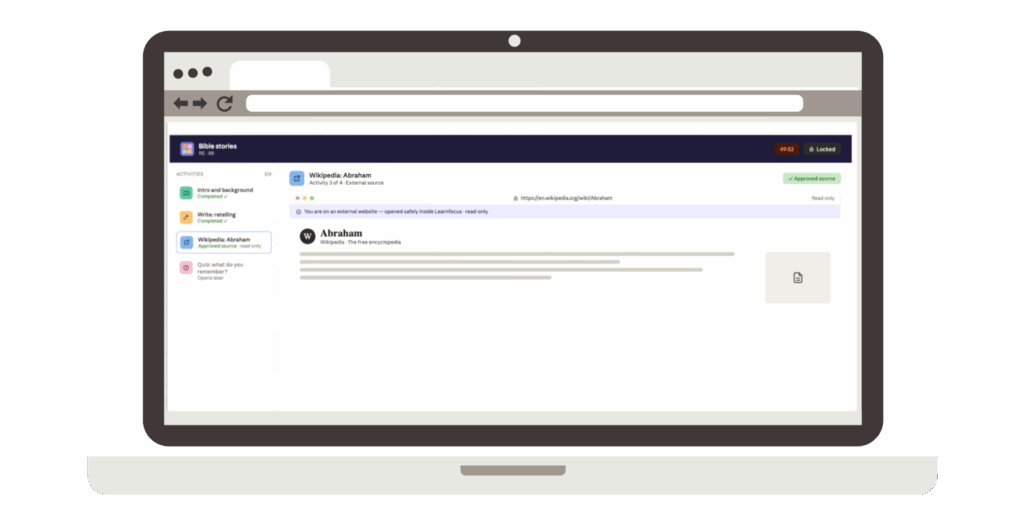
With Learning Focus, the teacher decides which Learnlab activities, websites and resources pupils can use during lessons. Teachers can block distracting websites on pupils’ devices without switching off the internet. This reduces distraction and gives the teacher greater control during the learning session.

This control over the learning session and its content supports focused work. Pupils who need language support or other adjustments can still access the necessary approved resources within the same learning environment.

Use Learning Focus in regular lessons, independent work and assessment situations. The teacher sets the boundaries according to the purpose of the session and pupils’ needs.

Read more about Learning focus

Create learning that builds relationships and a desire to learn

Let pupils ask questions, solve problems and create something together. Use interactive presentations, shared mind maps and collaborative assignments to make more voices visible and give pupils something to think about further.

Combine books, conversations, practical activities, physical activity and outdoor learning with digital tools when they contribute to better learning. An experiment, a trip or a local project can provide a starting point for documenting, analysing and communicating through text, photos, audio or video.

Set assignments that pupils can start at different levels and that also allow deeper exploration. This gives more pupils the opportunity to experience progress and contribute something valuable to the community.

Learning analytics that allows more time for follow-up

Learnlab collects information from learning activities and makes it available as advanced real-time learning analytics. Teachers receive support in understanding pupils’ comprehension, progress and need for further work.

Link activities to curriculum objectives and your own learning objectives. Use the insights to adjust teaching, ask better questions and provide feedback that helps pupils move forward.

School leaders can use aggregated analyses displayed in a leadership dashboard. These can be used to explore development across classes, subjects and year groups. This provides a basis for professional discussions about where the school is succeeding, where support is needed and what staff should work on next.

The analyses should be used for shared learning and improvement, with teachers’ professional judgement and knowledge of their pupils forming a central part of the picture.

Develop skills across education and children’s services

A strong team around a child needs relevant skills and opportunities to learn together.

With Learnlab, schools and municipalities can assess staff skills and development needs and use the results to plan targeted e-learning and joint development work. Set your own competency goals for the individual, team, service or municipality.

Build learning pathways in areas such as basic skills, language support, the school environment, relationship-building, assessment and digital judgement.

Combine e-learning with meetings focused on learning, practical trials and shared reflection. Follow up on how skills are applied, so development work leads to new ways of working with children and young people.

Listen to children, young people, parents, guardians and staff

Good decisions about learning and academic development require insight from multiple perspectives. Use surveys and facilitated reflection sessions to explore teaching quality, learning conditions, motivation, engagement and the support learners need to make progress.

Combine fixed response options with open-ended questions. AI-assisted summaries can make it easier to identify patterns, strengths and areas where further investigation is needed.

Use the insights as a starting point for dialogue: what helps children and young people learn and succeed? What do parents and guardians observe about their progress and motivation? What do staff need in order to provide more effective teaching and support?

Connect the findings to specific actions and follow up over time. This helps schools and municipalities evaluate what works, adjust their approach and create better conditions for academic achievement.

Strengthen collaboration between home and school

Parents and guardians are an important part of the team around a child. Good collaboration needs a shared language around learning, achievement, belonging and expectations.
Use interactive parent meetings and shared reflection to explore how home and school can support children together. Topics may include reading habits, inclusion, boundaries for digital activity and how adults can identify and address challenges early.
Make room for parents’ and guardians’ experiences and questions, and clarify how their input is followed up. The aim is a partnership in which the child experiences the adults working in the same direction.


Research-based development and responsible use of AI

Learnlab is built on research-based pedagogy. We research and further develop the solution together with AI-LEARN, and development is supported by the Research Council of Norway.
The platform makes it possible to turn research into learning resources, e-learning and the development of practice. Experiences and data from learning and development work can also provide a basis for new research when the necessary arrangements for data use are in place. AI can support planning, adaptation, feedback and analysis. Teachers and leaders are responsible for professional judgements and decisions.
Digital judgement is part of learning. Pupils should practise evaluating sources, think independently and consider when and how AI can be used appropriately. Its use is adapted to pupils’ ages, the purpose of the teaching and the conditions for learning.

A coordinated effort to help more children succeed

With Learnlab, municipalities and schools can connect children’s learning, staff skills and the organization’s development work.
Use the insights to prioritize support, develop shared practice and monitor whether measures contribute to better participation, achievement and teaching quality. This provides a stronger basis for directing resources where they are most needed and working over the long term to prevent underdevelopment and dropout.
How can you strengthen learning and the team around children and young people?

Everything you need for engaging learning and achievement

Learnlab brings a range of tools for teaching, collaboration and content creation together in one place. Create presentations, podcasts, videos, mind maps, quizzes and more. Let pupils use the same tools to explore, create and show what they have learnt.


Explore the tools

See how Learnlab can support high-quality teaching and skills development in your school or municipality.

Talk to us
