Learnlab for Organisations
E-learning and skills development that deliver measurable bottom-line results
E-learning and skills development that deliver measurable bottom-line results

Start with what you want to achieve. Should new employees become independent more quickly? Should customers get more value from your products? Or do you want to develop a course offering that generates new revenue?
With Learnlab, you can connect your organisation’s goals to the skills participants need and build learning pathways that support the development you want to achieve.
This gives you a stronger basis for prioritising training and investing where the need and expected value are greatest.
Bring onboarding, leadership development, product knowledge and professional updates together in connected learning pathways. Link training to roles, tasks and the organisation’s skills needs.
Help customers understand and use your products and services. Combine training with feedback and joint problem-solving, and use the insights to develop both the customer relationship and what you deliver.
Turn your expertise into courses, certification pathways and skills development programmes. Build an offering that combines e-learning, group sessions and follow-up, and give clients insights into participants’ completion and development. Whatever product or service you deliver, customers will have a better experience if it comes with straightforward, scalable training.
What skills do you have, and what do you need to achieve your goals?
Assess prior knowledge, experience and development needs before training begins. Combine self-assessment, knowledge questions and reflection to gain a broader picture of participants’ starting points.
Use your own competency goals and criteria tailored to roles, subject areas, internal standards or customer needs. Let the assessment guide content and follow-up, so participants spend their time on what is relevant to the work they will do.
Repeat the assessment over time to track development and identify the next skills needs.
Build courses around the situations participants encounter in their working day. Combine subject content with practical assignments, reflection and collaboration, and let them practise applying their knowledge.
Bring independent e-learning, online meetings and in-person sessions together in one learning pathway. Use text, video, interactive presentations, quizzes and other learning activities to suit the purpose.
AI helps you develop and refine content, while subject specialists ensure its quality. Also turn internal guidelines, procedures and product information into training that supports shared understanding and good practice.
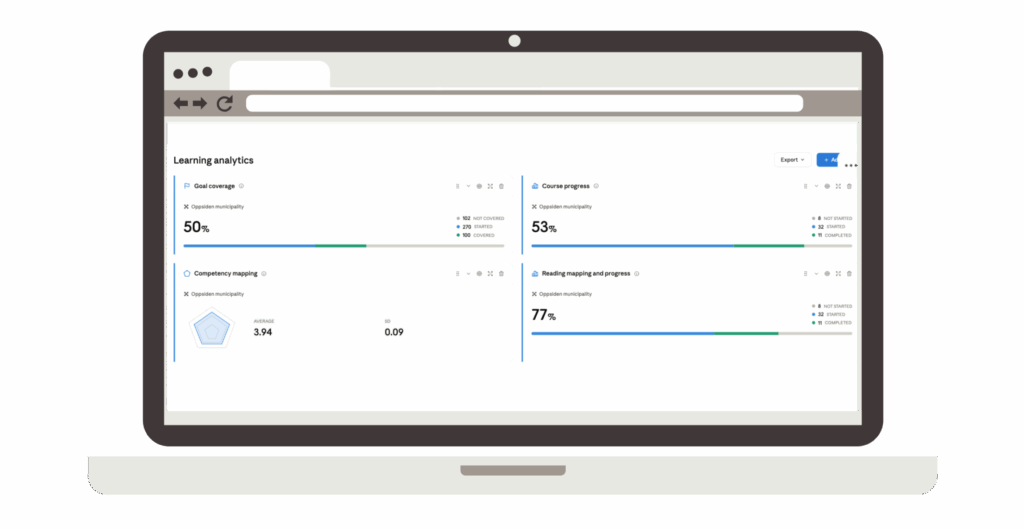
Gain insights as learning happens. Track participation, understanding and progress, and use AI-assisted analysis to explore patterns in responses, reflections and work.
Identify topics that need more attention, and adapt content and guidance along the way. View development in relation to the competency goals you have set for participants and the group.
Then use the learning insights alongside relevant key performance indicators from your organisation. For example, track whether a training initiative is associated with less time before employees can work independently, fewer errors, a reduced need for customer support or better sales results. This gives you a more concrete basis for assessing its contribution to the bottom line.
Let participants contribute their experiences, ask questions and solve tasks together. Interactive presentations and meetings focused on learning make it easier to involve more people, while language support and translation enable participation across languages.
With Learning Focus, the course leader decides which Learnlab activities and approved external websites or resources participants can access during a given session. This creates clear boundaries for focused learning and assessment.
The entire ecosystem is available for internal training, customer collaboration and learning programmes you deliver to others.
Learning creates value when knowledge is put into practice. Include assignments between sessions, let participants reflect on their own practice, and follow up with new activities and feedback.
Use the insights to assess who needs more support, which topics should be developed further and where the organisation should invest next.
This enables you to build a continuous process in which skills assessment, e-learning and follow-up support both individual development and organisational results.